
PRADHAN MANTRI SURAKSHA BIMA YOJANA (PMSBY) Why in News? Pradhan Mantri Suraksha Bima Yojana completed 10 years. Objectives: An Accident Insurance Scheme offering accidental death and disability cover for death or disability on account of an accident. Features: Ministry: Ministry of Finance Type: Central Sector Scheme Eligibility: Citizen (including NRIs) in the age group 18 to 70 years Premium rate: ₹ 20 per annum per member Enrolment period: The cover shall be for one-year period stretching from 1st June to 31st May Implementing agency: The scheme is offered / administered through the Public Sector General Insurance Companies (PSGICs) and other general insurance companies willing to offer the product with necessary approvals on similar terms, in collaboration with participating Banks.– Participating banks are free to engage any such general insurance company for implementing the scheme for their account holders/subscribers. Conditions: – A bank or post office account, and– Consent to enable auto debit of premium. Coverage: – ₹ 2 lakh for accidental death or total permanent disability. – ₹ 2 lakh for total and irrecoverable loss of both eyes or loss of use of both hands or feet or loss of sight of one eye and loss of use of hand or foot. – ₹1 lakh for partial permanent disability. – ₹1 lakh for total and irrecoverable loss of sight of one eye or loss of use of one hand or foot. Other key features:– Natural calamities are also covered under PMSBY.– Individuals who exit the scheme at any point may re-join the scheme in future years by paying the annual premium. Impact: – 44+ crore enrolled since launch. – Major beneficiaries: 50.16% women and 72.24% from rural areas. Rashtram Institute Rashtram Institute for Civil Services is destined to provide you the best curated content for civil services examination on both mains and prelims perspective. Follow us for more such content…. To register, call: 9964152111Seats are filling fast — register today and step into the exam hall with full confidence! Address: Jaynagar last, Bus Stop, Saptapur, Dharwad, Karnataka 580001
PRIVATE MEMBER BILL
PRIVATE MEMBER BILL What is a Private Member’s Bill?A Member of Parliament, other than a Minister (both elected and nominated) is known as a Private Member. A bill initiated by any such Member is called a Private Member’s Bill (PMB). Drafting of such a bill is responsibility of the Member introducing it. Mechanism: A one-month notice is given before the introduction of the bill with the permission of Speaker (Lok Sabha) or Chairman (Rajya Sabha). If the bill is selected then:– Lok Sabha allots last two-and-a-half hours of business every Friday for consideration and discussion on the Bill.– Rajya Sabha allots two and a half hours (from 2.30 p.m. to 5.00 p.m.) on every a alternate Friday.– The first private member bill passed was the Muslim wakfs bill,1952 which was introduced by Syed Mohammed Ahmad Kasmi. What is the significance of PMBs? Policy Innovation: They allow MPs to propose novel ideas or address issues overlooked by the government.g., Right to Disconnect Bill 2019 introduced by a private member, granting employees the legal right to disengage from work-related communication beyond official working hours. Reform Potential: They can spark debate on outdated laws or emerging issues.g., The Rights of Transgender Persons Bill, 2014, was first introduced by a Private Member which then inspired the government to introduce its own Bill on transgender rights. Expression Beyond Party Line: They enable MPs to voice independent views, free from party whip constraints under 10th Schedule, fostering democratic participation. Checks and Balances: These act as a tool for MPs to hold the government accountable by proposing alternative policies. Why are PMBs in Decline? Disruptions: Frequent adjournments and chaotic sessions reduce time for PMB discussions. g., in the 17th Lok Sabha (2019-24), 729 PMBs were introduced in the Lok Sabha and 705 in the Rajya Sabha. However, only 2 in the Lok Sabha and 14 in the Rajya Sabha were ever discussed. Procedural Issues: It takes years for legislation moved by private members to come up for discussion due to limited time (only 2–3 hours weekly).The Speaker/Chairman’s discretionary power to admit or reject bills can be influenced by political considerations. Resource Constraints: Private members lack research support, drafting expertise, or institutional backing, unlike government bills. Low Success Perception: The historically low passage rate discourages MPs from investing effort in PMBs.g., only 14 private member bills have become law till date and the last such bill was passed in 1970. Lack of Political Will: Many private MPs have pointed out that governments prioritize their own legislative agenda, sidelining PMBs. Way Forward Streamlining Procedures: Allocate fixed, uninterrupted time for PMB discussions, digital tracking of such bills, etc. to ensure at least a few bills are debated each session. Amendments to the Rules of Procedure and Conduct of Business can explicitly protect the allotted time from being overridden by other agendas. Research Support: Establish a dedicated research unit (like the UK’s Public Bill Committee) to assist MPs in drafting robust bills. Institutionalised Mechanism: Parliament can introduce a dedicated review committee for screening Bills for quality, relevance, and constitutionality and recommend a priority list for discussion based on public importance and encouraging cross-party support.UK’s 10-Minute Rule Model can also be adopted where MPs can introduce short bills with brief speeches to make their case for a new Bill. Rashtram Institute Rashtram Institute for Civil Services is destined to provide you the best curated content for civil services examination on both mains and prelims perspective. Follow us for more such content…. To register, call: 9964152111Seats are filling fast — register today and step into the exam hall with full confidence! Address: Jaynagar last, Bus Stop, Saptapur, Dharwad, Karnataka 580001
ATAL PENSION YOJANA (APY)
ATAL PENSION YOJANA (APY) Why in News?Atal Pension Yojana completed 10 years. Features: Ministry: Ministry of Finance Launched in: 2015 Implementing agency: Pension Fund Regulatory and Development Authority (PFRDA) under the National Pension System (NPS). Type: Central Sector Scheme Eligibility: APY is open to all bank account holders in the age group of 18 to 40 years who are not income tax payers. All eligible family members can join scheme. Benefits: Guaranteed Monthly Pension: Lifelong pension between ₹1,000 to ₹5,000 from age 60 until death. Family Pension Provision: In case of death of subscriber, spouse receives the pension; nominee gets corpus. Premature death of the subscriber (before 60 years of age): Spouse can continue contribution to APY account. Payment: Subscribers can make contributions to APY on monthly/ quarterly / half-yearly basis. Depending upon the intended/desired monthly pension and the age of subscriber at entry. Exit and Withdrawal Options: Exit at age 60: Full pension begins. Exit before age 60: Permitted only in cases of death or terminal illness. Voluntary Exit: Allowed, but the subscriber only receives the contribution made (with interest) and government co contribution (if any) is forfeited. Government Co-contribution (for Early Joiners): For eligible subscribers who joined between 1 June 2015 and 31 March 2016 (The scheme is continued but without Government Co-contribution). The government co-contributed 50% of the total contribution or ₹1,000 per annum (whichever is lower) for 5 years. This applied only to subscribers not covered under any statutory social security scheme and not income taxpayers at the time. Achievements in ten years: Females constitute around 47% of total subscribers enrolled under Scheme As on April 2025, more than 7.66 crore individuals have subscribed to the scheme. Objectives: To encourage voluntary savings for retirement by offering defined pension benefits, linked to the age of joining and amount of contribution. To create a universal social security system for all, especially the poor, under-privileged and workers in the unorganized sector. To provide financial security in old age Rashtram Institute Rashtram Institute for Civil Services is destined to provide you the best curated content for civil services examination on both mains and prelims perspective. Follow us for more such content…. To register, call: 9964152111Seats are filling fast — register today and step into the exam hall with full confidence! Address: Jaynagar last, Bus Stop, Saptapur, Dharwad, Karnataka 580001
INDIA-NAMIBIA RELATION
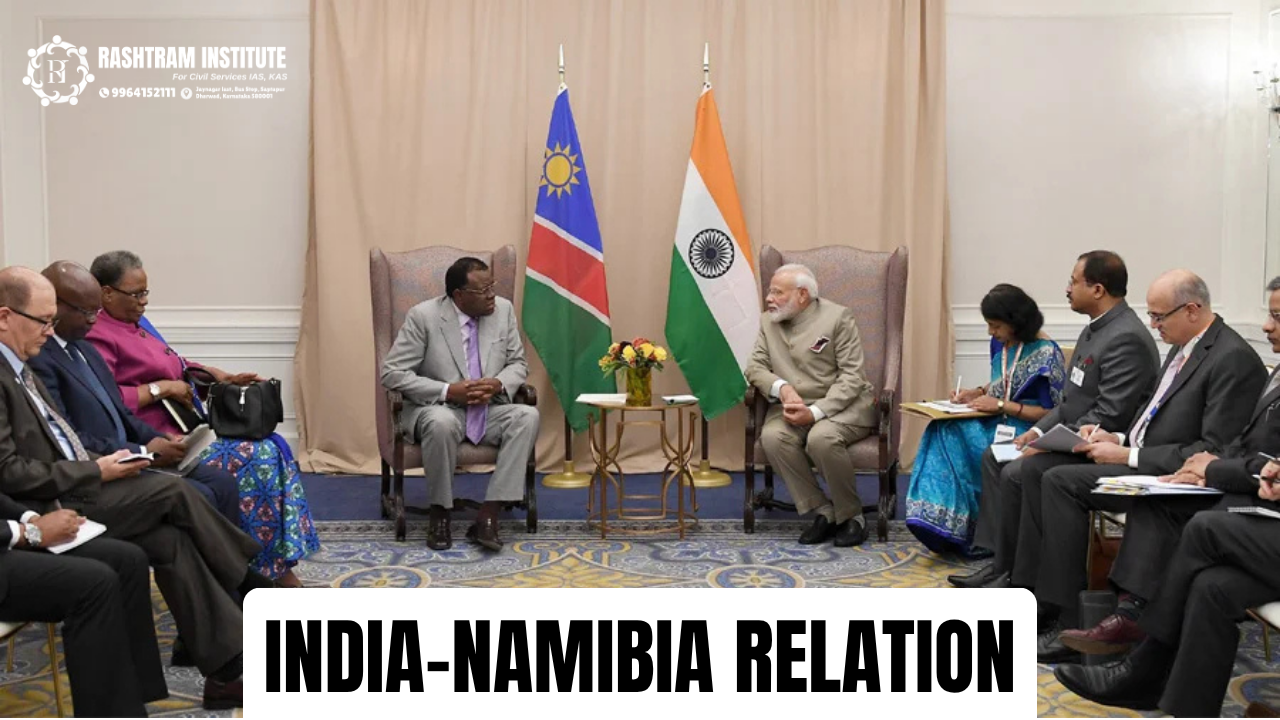
INDIA-NAMIBIA RELATION Why in News? India’s Prime Minister undertook a State Visit to Namibia (the first by an Indian PM in 27 years) addressed the Namibian Parliament, and reaffirmed India’s commitment to a partnership with Africa founded on dialogue, not dominance. Highlights of the visit: Prime Minister became the first Indian leader to receive Namibia’s highest civilian award, the Order of the Most Ancient Welwitschia Mirabilis. Namibia submitted its letter of acceptance to join the Coalition for Disaster Resilient Infrastructure (CDRI). It also accepted membership in the Global Biofuels Alliance. Namibia became one of the first African countries to adopt India’s Unified Payments Interface (UPI)platform, enhancing digital financial inclusion. Namibia was invited to join India’s Jan Aushadhi programme, which reduces medicine costs by 50–80% India-Namibia Relation: Historical and Political Ties:India was among the first countries to raise Namibia’s independence at the United Nations in 1946, extended material and diplomatic support to South West Africa People’s Organisation (SWAPO led Namibia’s liberation struggle). Cheetah Translocation Project: In 2022, India received eight cheetahs from Namibia, achieving the world’s first intercontinental relocation of a major carnivore species. Development Assistance:India provided 30,000 Covishield doses to Namibia, and established the India-Namibia Centre of Excellence in IT (INCEIT) and an India Wing at the University of Namibia. Economic Relations:Bilateral trade stood at USD 568.40 million in 2024–25, with key sectors including mining, energy, agriculture, education, infrastructure, health, and trade. Location: Namibiais a Southern African nation with its western boundary formed by the Atlantic Ocean. Namibia shares its northern borders with Angola and Zambia, while Botswana lies to the east, and South Africa borders its eastern and southern regions. Rashtram Institute Rashtram Institute for Civil Services is destined to provide you the best curated content for civil services examination on both mains and prelims perspective. Follow us for more such content…. To register, call: 9964152111Seats are filling fast — register today and step into the exam hall with full confidence! Address: Jaynagar last, Bus Stop, Saptapur, Dharwad, Karnataka 580001
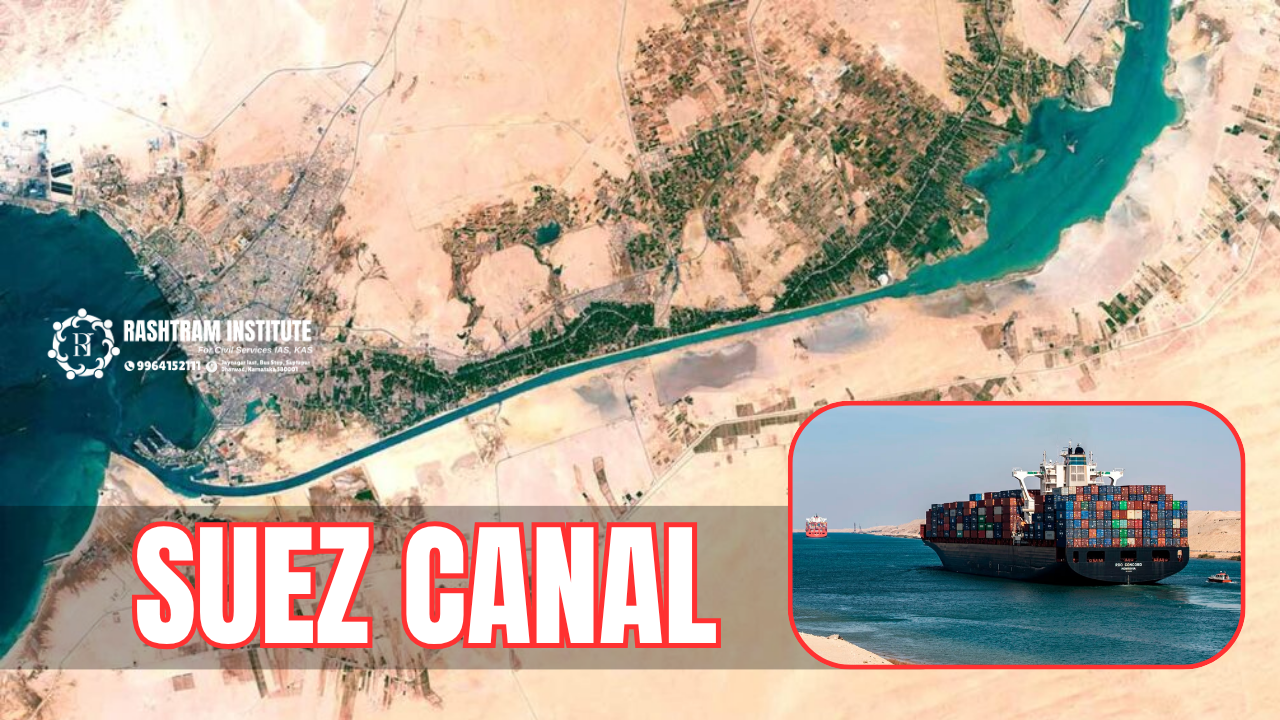
SUEZ CANAL
SUEZ CANAL The Suez Canal is an artificial sea-level waterway running north–south across Egypt’s Isthmus of Suez. It is a vital international shipping route, connecting the Mediterranean Sea to the Indian Ocean via the city of Suez on the Red Sea. The canal connects Port Said on the Mediterranean Sea to the Indian Ocean via the Egyptian city of Suez on the Red Sea. It serves as a crucial international shipping route, allowing vessels to navigate between Europe and Asia without having to circumnavigate the African continent. It is one of the world’s most heavily used shipping lanes, carrying over 12% of world trade by volume. It provides a crucial link for oil, natural gas and cargo being shipped from East to West. History: The idea of constructing a canal across the Isthmus of Suez dates back to ancient times. It was during the nineteenth century that significant efforts were made. Constructed by the Suez Canal Company, led by French diplomat Ferdinand de Lesseps. Opened in 1869. Originally under joint British-French control; nationalized by Egypt in 1956 under President Gamal Abdel Nasser—leading to the Suez Crisis. Importance: Strategic Trade Route: Allows ships to avoid the long route around the Cape of Good Hope. For International trade: The canal carries – 12% of world trade, 7% of world’s oil, 30% container – ship daily. Reduces travel time between Europe and South Asia/East Asia by about 7,000 km. Source of revenue to Egypt: It is a major source of revenue for Egypt. The revenue from the canal in 2022 reached $8 billion. Energy Security: The canal’s location makes it a key link for shipping crude oil and other hydrocarbons from countries such as Saudi Arabia to Europe and North America. Importance for India: Indian trade worth $200 billion to/from North America, South America and Europe is carried out using this route. It enables the Indian Navy to project its presence in the region and participate in global naval operations. This highlights its strategic importance for India. Challenges: Navigational Bottlenecks and Blockages: The canal is narrow in certain stretches, especially the older sections. Geopolitical Tensions: for example, Israel-Palestine war, Arab-Israeli wars. Security Threats: region is vulnerable to terrorist attacks, sabotage, military blockades (Houthi attacks) Climate Change and Rising Sea Levels: Rising temperatures and water salinity can affect canal operations and nearby ecosystems. Potential sea-level rise could lead to coastal erosion or impact canal infrastructure over time. Rashtram Institute Rashtram Institute for Civil Services is destined to provide you the best curated content for civil services examination on both mains and prelims perspective. Follow us for more such content…. To register, call: 9964152111Seats are filling fast — register today and step into the exam hall with full confidence! Address: Jaynagar last, Bus Stop, Saptapur, Dharwad, Karnataka 580001
VICE PRESIDENT OF INDIA
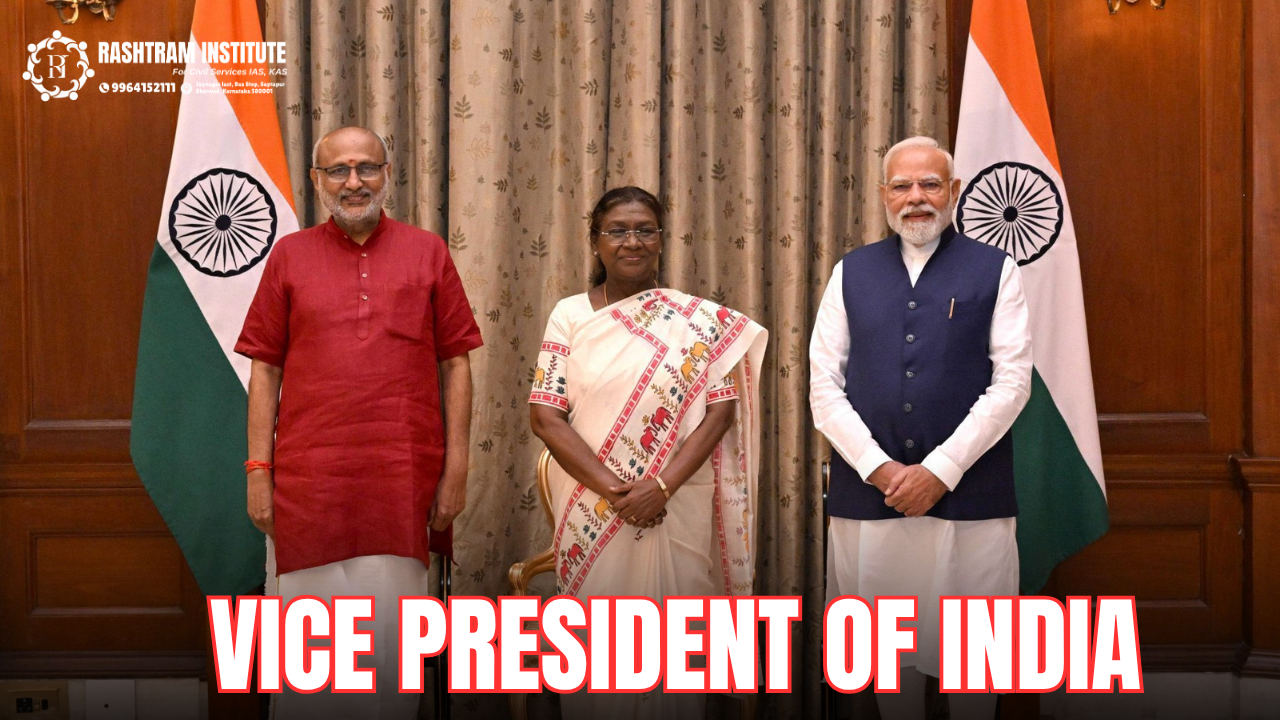
VICE PRESIDENT OF INDIA Why in News?Vice President Jagdeep Dhankhar resigns from office citing health issues. About Vice President post: The Vice President of India is the second-highest constitutional office in the country after the President of India. The Vice-President is accorded a rank next to the President in the official warrant of precedence. This office is modelled on the lines of the American Vice-President. The Vice President’s main role is to act as the President if the President cannot perform his or her duties, such as due to death, resignation, or impeachment. The Vice President also serves as the Chairman of the Rajya Sabha (Council of States), the upper house of the Indian Parliament. Constitutional Provisions: Article 63 – There shall be a Vice President of India Article 64 – The Vice President shall be ex officio chairman of the council of States Article 65 – Vice President to act as President or to discharge his functions during casual vacancies in the office, or during the absence, of President Article 66 – Vice President shall be elected by the members of an electoral college consisting of the members of both Houses of Parliament in accordance with the system of proportional representation Article 67 – Vice President shall hold office for a term of five years Article 68 – Provisions related to the term and vacancy of the Vice President Article 69 – Oath to the office of President Article 70 – Discharge of Presidents functions in any contingencies Article 71 – Matters and disputes relating to, or connected with, the election of a President or Vice President. Election to the post of Vice President: The election to the post held indirectly like the election to the post of President. Under Article 324 of the Constitution of India, the authority to conduct elections to the Office of Vice-President is vested in the Election Commission of India. As per Article 66(1) of the Constitution of India, the election of the Vice President shall be held in accordance with the system of proportional representation by means of single transferable vote and the voting at such election shall be by secret ballot. The Vice-President is elected by an Electoral College, which consists of the members of the Lok Sabha and Rajya Sabha (both elected and nominated members) Election to the office of Vice-President of India is governed by the provisions contained in Articles 64 to 68 of the Constitution of India and the Presidential and Vice-Presidential Elections Act, 1952 and the Rules made thereunder Qualifications: A candidate should satisfy the following requirements to contest the election to the Office of Vice-President: – Must be a citizen of India. Must have completed 35 years of age. Must be eligible to be a member of the Rajya Sabha. Must not hold any office of profit under the Government of India or the Government of any State or under any local or other authority subject to the control of any of the said Governments. {The offices of President and Vice-President, Governor of any State and Ministers of Union or State are not deemed to be office of profit for this purpose} Oath and Affirmation: Before entering his office, the Vice President has to make and subscribe to an oath or affirmation. In his oath, the Vice President swears. to bear true faith and allegiance to the Constitution of India; and to faithfully discharge the duties of his office. The oath of office to the Vice-President is administered by the President or some person appointed by him. Term of Office: The Vice-President holds office for a term of 5 years from the date he enters upon his office. Even after the expiry of the 5-year term, he continues to hold office until his successor assumes charge. In case of death, removal, or resignation, the Constitution does not provide for automatic succession. A fresh election must be conducted to fill the vacancy. During the interim period, the Deputy Chairman of the Rajya Sabha can perform the duties of the Chairman. Resignation and Removal: Voluntary Resignation Under Article 67(a) Vice Presidents can resign by submitting a written letter to the President, which becomes effective immediately upon acceptance. The present Vice President’s resignation invokes Article 67(a), citing medical advice as the primary reason for his decision. Removal Process: Parliamentary Accountability Article 67(b) outlines the removal procedure of the Vice President. It requires an effective majority in the Rajya Sabha and simple majority in the Lok Sabha, with a mandatory 14-day advance notice. This process is notably simpler than the Presidential impeachment which requires two-thirds majority in both houses for ‘constitutional violations.’ This reflects the Vice President’s primary accountability as the Rajya Sabha Chairman. List of Vice Presidents of India from 1952 to 2025: S.No. Name Term of Office 1 Dr. Sarvepalli Radhakrishnan 13 May 1952 – 12 May 1957 13 May 1957 – 12 May 1962 2 Dr. Zakir Hussain 13 May 1962 – 12 May 1967 3 V. V. Giri 13 May 1967 – 3 May 1969 4 Gopal Swarup Pathak 31 August 1969 – 30 August 1974 5 B. D. Jatti 31 August 1974 – 30 August 1979 6 Mohammad Hidayatullah 31 August 1979 – 30 August 1984 7 R. Venkataraman 31 August 1984 – 24 July 1987 8 Dr. Shankar Dayal Sharma 3 September 1987 – 24 July 1992 9 K. R. Narayanan 21 August 1992 – 24 July 1997 10 Krishan Kant 21 August 1997 – 27 July 2002 11 Bhairon Singh Shekhawat 19 August 2002 – 21 July 2007 12 Mohammad Hamid Ansari 11 August 2007 – 11 August 2012 11 August 2012 – 10 August 2017 13 M. Venkaiah Naidu 11 August 2017 – 10 August 2022 14 Jagdeep Dhankhar 11 August 2022 – 22 July 2025 (The three Vice Presidents of India who resigned before completing their term are V. V. Giri, R. Venkataraman, and Jagdeep Dhankhar) Rashtram Institute Rashtram Institute for Civil Services is
GROUP OF SEVEN (G7)
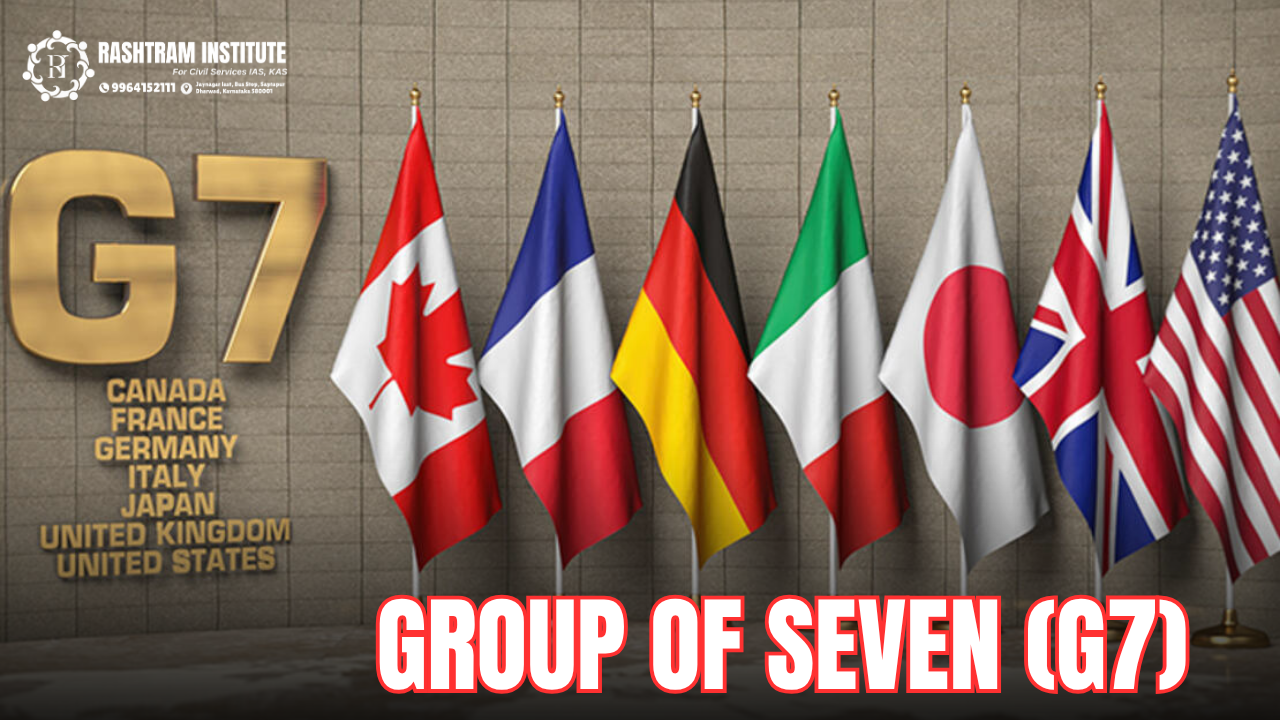
GROUP OF SEVEN (G7) Why in News? The 51st G7 Summit, held in Kananaskis, Canada and hosted by Canadian PM Mark Carney, brought together G7 leaders and guest heads, including the Prime Minister of India, to address global tensions and shifting geopolitical dynamics. Key Outcomes of 51st G7 Summit (2025) Summit: Kananaskis Wildfire Charter: Adopted a “whole of society” approach, including Indigenous knowledge, sustainable forest management, and awareness campaigns (endorsed by India). G7 Critical Minerals Action Plan: Secure sustainable and resilient supply chains for critical minerals. Key Initiatives on Artificial Intelligence (AI): G7 GovAI Grand Challenge and a shared G7 AI Network (GAIN). About G7: Formed in the year 1975 in response to economic and financial cooperation due to energy crisis. Members: United States, UK, France, Germany, Italy, Japan and Canada(Russia was a member from 1998 to 2014, during which the forum was called the G8. Russia’s annexation of Crimea in March 2014 led to its suspension from the group.) There are no formal criteria for membership,but participants are all highly developed democracies. Purpose and Agenda: Meets annually to deliberate on key global issues such as: Global economic governance, international security. Energy policy, etc. Structure:The G7 lacks a formal institutional structure. It does not have a charter or a permanent secretariat. Presidency:The presidency of the G7 rotates annually among the member countries. Significance: Wealth:Control 60% of global net wealth Growth:Drive 46% of global GDP Population:Represents 10% of the world’s population. Relevance of G7 Innovations in Governance: The introduction of initiatives like the “Hiroshima AI Process” highlights the G7’s role in addressing emerging technological challenges. Ukraine Crisis: The G7 coordinated sanctions against Russia & supported Ukraine with financial packages from frozen Russian assets. Rise of China: China’s rise as a major economic and political power has altered the global balance. China’s Belt and Road Initiative (BRI) leading to a “debt trap” raises concerns amongst the G-7 nations. Significance of G7 for India: Strategically Balancing the West and the Global South: India positions itself as a bridge between the industrialized West (G7) and the Global South. Economic & Technological Cooperation:g., India has been a strong proponent of initiatives like the G7’s PGII, which aims to invest in infrastructure in developing countries. Democracy & Strategic Weight: India’s democratic credentials and economic growth (4th largest economy) make its voice influential within G7 dialogues. Platform for Bilateral talks:g., Indian PM met Canadian PM to reset the deteriorating relations. Rashtram Institute Rashtram Institute for Civil Services is destined to provide you the best curated content for civil services examination on both mains and prelims perspective. Follow us for more such content…. To register, call: 9964152111Seats are filling fast — register today and step into the exam hall with full confidence! Address: Jaynagar last, Bus Stop, Saptapur, Dharwad, Karnataka 580001
NASA-ISRO SYNTHETIC APERTURE RADAR (NISAR) SATELLITE
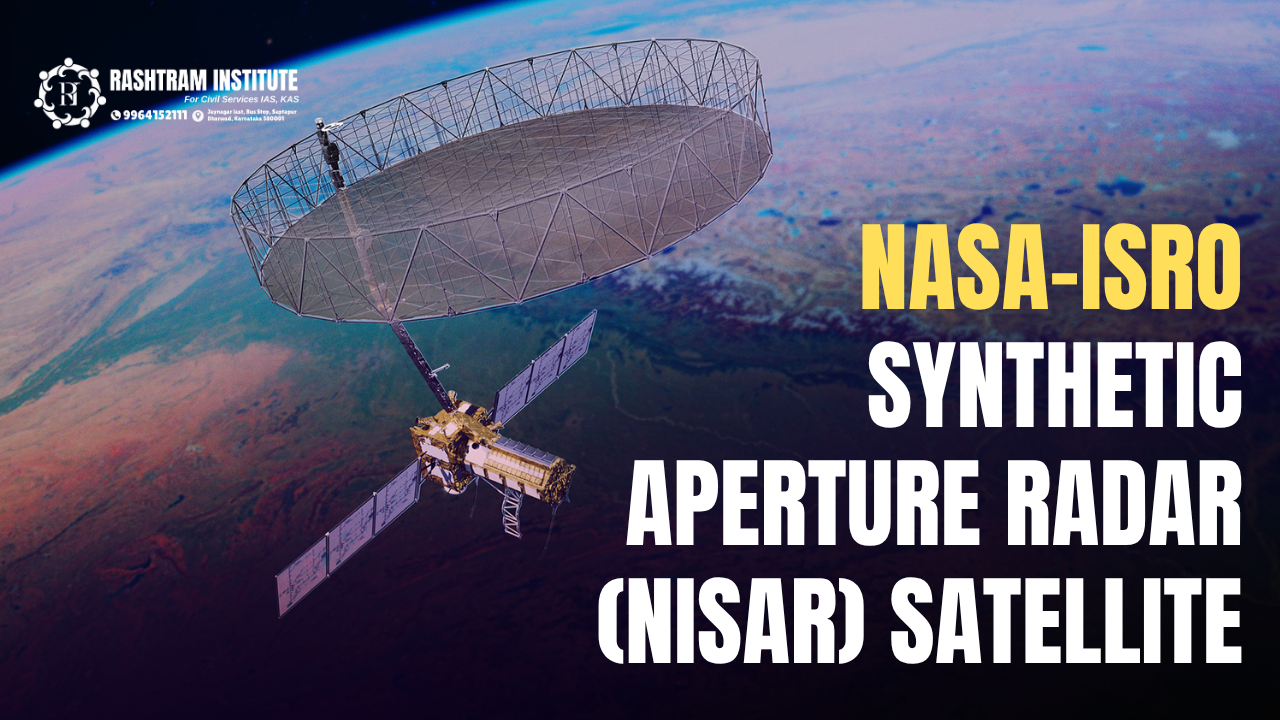
NASA-ISRO SYNTHETIC APERTURE RADAR (NISAR) SATELLITE Why in News?NASA-ISRO Synthetic Aperture Radar (NISAR) Satellite launched from Satish Dhawan Space Centre, Srihari Kota on 30th July, 2025 About NISAR Satellite: Jointly developed by NASA and ISRO, the NASA-ISRO Synthetic Aperture Radar (NISAR) is the world’s first Earth observation satellite to carry dual-frequency synthetic aperture radars, L-band by NASA and S-band by ISRO, on a single platform. It will deliver high-resolution, all-weather, day-and-night imagery of Earth’s land and ice surfaces, revisiting each location every 12 days. Launched aboard through GSLV-F16 launch vehicle (this was the first time ISRO’s GSLV vehicle successfully placed a satellite into a Sun-synchronous Polar Orbit) This 18th flight of the GSLV and the 12th using the indigenous cryogenic stage. Weight: 2393 kg Built around ISRO’s I-3K spacecraft bus NASA provided the L-band radar, GPS receiver, high-rate telecom system, Solid-State Recorder, and the 12-meter deployable antenna ISRO contributed the S-band radar, the spacecraft bus, the GSLV-F16 launch vehicle, and associated systems and services. The mission, estimated to cost over $1.5 billion, is jointly funded by both agencies. Rashtram Institute Rashtram Institute for Civil Services is destined to provide you the best curated content for civil services examination on both mains and prelims perspective. Follow us for more such content…. To register, call: 9964152111Seats are filling fast — register today and step into the exam hall with full confidence! Address: Jaynagar last, Bus Stop, Saptapur, Dharwad, Karnataka 580001

UN WOMEN
UN WOMEN Why in News?UN Women recently marked 15 years since its establishment. About UN Women: UN Women, founded by the UN General Assembly in July 2010, serves as the UN’s principal body for promoting gender equality and women’s empowerment. As part of the UN reform agenda, UN Women was created through the merger of four existing entities: Division for the Advancement of Women (DAW) International Research and Training Institute for the Advancement of Women (INSTRAW) Office of the Special Adviser on Gender Issues and Advancement of Women (OSAGI) United Nations Development Fund for Women (UNIFEM). Core Mission of UN Women: Governance & Leadership: Promote equal participation of women in decision-making at all levels. Economic Empowerment: Advocate for equal pay, decent work conditions, and financial autonomy for women. Ending Violence Against Women: Work towards the elimination of all forms of gender-based violence. Peace & Humanitarian Action: Strengthen women’s involvement in peace processes, conflict resolution, and humanitarian response. Key Issues Faced by Women (as per UN Women): Political Backlash & Declining Rights:In 2024, about 1 in 4 countries experienced backlash against women’s rights, reflecting a regressive trend in gender equality efforts. Legal Inequality:Globally, women enjoy only 64% of the legal rights that men have, with 51% of countries placing restrictions on women working in the same jobs as men. Underrepresentation in Governance:Women constitute only 25% of lawmakers worldwide, highlighting persistent gender gaps in political decision-making. Negligible Funding for Gender Equality:Just 4% of official development assistance (ODA) during 2021–2022 was allocated specifically to advancing gender equality. Gender-Based Violence:In 2023, 85,000 women and girls were intentionally killed — approximately one every 10 minutes, often by an intimate partner or close relative. Exclusion from Peace Processes:Between 2020 and 2023, 80% of peace talks and 70% of mediation efforts excluded women, underscoring their continued marginalization in conflict resolution and peacebuilding initiatives. Economic Inequality: Gender Pay Gap:Women earn 20% less than men globally for work of equal value. Unpaid Care Work:Women perform 5 times more unpaid care and domestic work than men, limiting their economic opportunities and financial independence. Poor Health Access:Nearly 800 women die daily from preventable causes related to pregnancy and childbirth, reflecting gaps in access to quality maternal healthcare and reproductive services. UN Women’s Key Solutions: Promote Gender-Inclusive Peacebuilding:UN Women advocates increased investment in conflict prevention, enhanced participation of women in peace processes, and better access to reproductive healthcare in conflict-affected areas. Strengthen Leadership & Political Will:UN Women calls for stronger political commitment, gender-responsive governance, removal of discriminatory laws, and greater inclusion of women in leadership especially in areas like climate action. Advance Economic Empowerment:UN Women promotes equal pay, stronger anti-discrimination laws, and investment in care infrastructure to reduce unpaid care work and create up to 300 million jobs by 2035. Enhance Access to Education & Technology:UN Women suggests reducing education costs, providing cash incentives, ensuring safe and inclusive learning spaces, improving digital access and online safety, and boosting public-private funding for gender equality. UPSC CSE Mains:Distinguish between ‘care economy’ and ‘monetized economy’. How can the care economy be brought into a monetized economy through women empowerment? (2023) “Empowering women is the key to control population growth”. Discuss. (2019) Rashtram Institute Rashtram Institute for Civil Services is destined to provide you the best curated content for civil services examination on both mains and prelims perspective. Follow us for more such content…. To register, call: 9964152111Seats are filling fast — register today and step into the exam hall with full confidence! Address: Jaynagar last, Bus Stop, Saptapur, Dharwad, Karnataka 580001
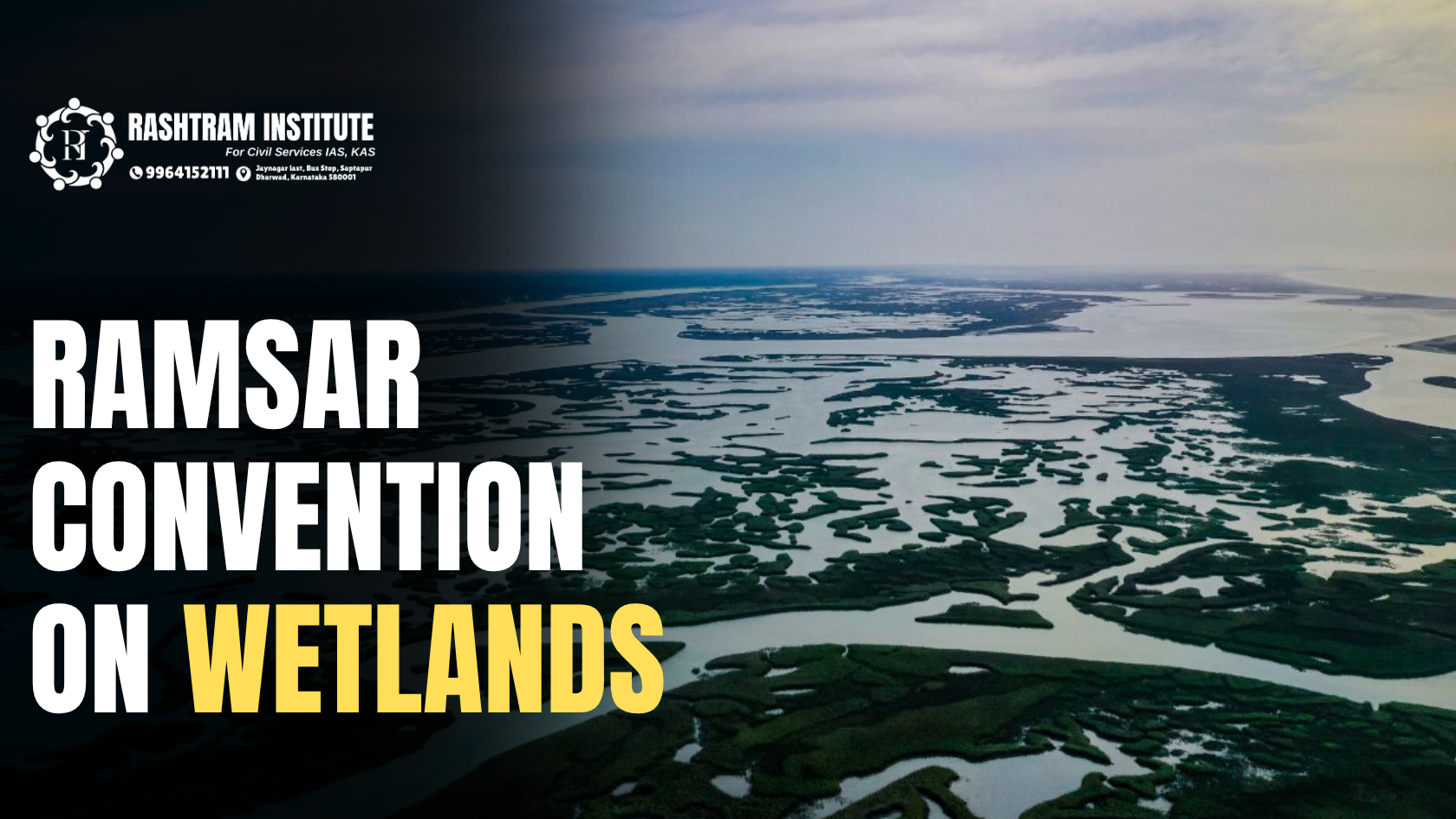
RAMSAR CONVENTION ON WETLANDS
RAMSAR CONVENTION ON WETLANDS Why in News?India’s resolution to the Ramsar Contracting Parties on ‘Promoting Sustainable Lifestyles for the Wise Use of Wetlands’, adopted at Ramsar CoP15 in Zimbabwe About RAMSAR CoP 15: The 15th Meeting of the Conference of the Parties (COP15) to the Ramsar Convention on Wetlands concluded in Victoria Falls, Zimbabwe Victoria Falls Declaration: It underscores the need for political commitment, increased resource mobilisation, and investment in wetland management. Adoption of 13 Resolutions: The parties agreed to enhance flyway conservation for migratory birds, launch the Global Waterbird Estimates Partnership, and safeguard species such as river dolphins. 5thRamsar Strategic Plan: Parties adopted the 5th Strategic Plan with 4 goals and 18 targets. The STRP (Scientific and Technical Review Panel) will monitor progress. Goal 1: Address and reverse wetland loss and degradation. Goal 2: Achieve the wise use of Wetlands through policy planning and inclusive participation. Goal 3: Conserve and Manage Wetlands of International Importance effectively. Goal 4: Enhance implementation of the Convention through scientific cooperation, capacity building, and raising money India’s Resolution on the Wise Use of Wetlands India’s resolution on “Promoting Sustainable Lifestyles for the Wise Use of Wetlands” was successfully adopted on receiving support from all 172 countries at Ramsar COP15 This resolution aligns with the ethos of India’s Mission LiFE (Lifestyle for Environment) initiative, which was introduced by the Indian Prime Minister at COP26 in Glasgow in 2021. The Resolution builds upon Resolution 6/8 on ‘Promoting Sustainable Lifestyles’ adopted at the Sixth UN Environment Assembly in March 2024. Ramsar Convention: The Ramsar Convention on Wetlands (1971) is the only global environmental treaty dedicated to wetlands. The Convention was adopted in the Iranian city of Ramsar in 1971and came into force in 1975. Almost 90% of UN member states have acceded to become “Contracting Parties”. India became a partyto the Ramsar Convention on February 1, 1982. RAMSAR Sites in India: At present, India has a total of 91 Ramsar Sites, the highest in Asia (recently added: Khichan and Menar, both in Rajasthan) State / UT No. of Sites Ramsar Sites Andhra Pradesh 1 Kolleru Lake Assam 1 Deepor Beel Bihar 3 Kanwar Lake, Nagi Bird Sanctuary, Nakti Lake Goa 1 Nanda Lake Gujarat 4 Khijadiya, Nalsarovar, Thol Lake, Wadhvana Wetland Haryana 2 Sultanpur National Park, Bhindawas Wildlife Sanctuary Himachal Pradesh 3 Chandra Taal, Pong Dam Lake Wildlife Sanctuary, Renuka Lake Jammu & Kashmir 5 Hokersar Wetland, Hygam Wetland Conservation Reserve, Shallabugh Wetland, Mansar-Surinsar Wildlife Sanctuary, Wular Lake Jharkhand 1 Udhwa Lake Karnataka 4 Ranganathittu Bird Sanctuary, Ankasamudra Bird Conservation Reserve, Aghanashini Estuary, Magadi Kere Conservation Reserve Kerala 3 Ashtamudi Wetland, Sasthamkotta Lake, Vembanad-Kol Wetland Ladakh 2 Tso Kar, Tsomoriri Lake Madhya Pradesh 5 Bhoj Wetland, Sakhya Sagar, Sirpur Lake, Yashwant Sagar, Tawa Reservoir Maharashtra 3 Lonar Lake, Nandur Madhameshwar, Thane Creek Manipur 1 Loktak Lake Mizoram 1 Pala Wetland Odisha 6 Ansupa Lake, Bhitarkanika Mangroves, Chilika Lake, Hirakud Reservoir, Satkosia Gorge, Tampara Lake Punjab 6 Beas Conservation Reserve, Harike Wetland, Kanjli Wetland, Keshopur-Miani Community Reserve, Nangal Wildlife Sanctuary, Ropar Wetland Rajasthan 4 Keoladeo National Park, Sambhar Lake, Khichan, Menar Sikkim 1 Khecheopalri Wetland Tamil Nadu 20 Chitrangudi Bird Sanctuary, Gulf of Mannar Marine Biosphere Reserve, Kanjirankulam Bird Sanctuary, Karaivetti Bird Sanctuary, Karikili Bird Sanctuary, Koonthankulam Bird Sanctuary, Longwood Shola Reserve Forest, Pallikarnai Marsh Reserve Forest, Pichavaram Mangrove, Point Calimere Wildlife and Bird Sanctuary, Suchindram Theroor Wetland Complex, Udhayamarthandapuram Bird Sanctuary, Vadavur Bird Sanctuary, Vedanthangal Bird Sanctuary, Vellode Bird Sanctuary, Vembannur Wetland Complex, Nanjarayan Bird Sanctuary, Kazhuveli Bird Sanctuary, Sakkarakottai Bird Sanctuary, Therthangal Bird Sanctuary Tripura 1 Rudrasagar Lake Uttar Pradesh 10 Bakhira Sanctuary, Haiderpur Wetland, Nawabganj Bird Sanctuary, Parvati Arga Bird Sanctuary, Saman Bird Sanctuary, Samaspur Bird Sanctuary, Sandi Bird Sanctuary, Sarsai Nawar Jheel, Sur Sarovar, Upper Ganga River Uttarakhand 1 Asan Barrage West Bengal 2 East Kolkata Wetlands, Sundarban Wetland Rashtram Institute Rashtram Institute for Civil Services is destined to provide you the best curated content for civil services examination on both mains and prelims perspective. Follow us for more such content…. To register, call: 9964152111Seats are filling fast — register today and step into the exam hall with full confidence! Address: Jaynagar last, Bus Stop, Saptapur, Dharwad, Karnataka 580001